> ## Documentation Index
> Fetch the complete documentation index at: https://mintlify.com/vectifyai/pageindex/llms.txt
> Use this file to discover all available pages before exploring further.
# Introduction
> Next-generation vectorless, reasoning-based RAG that mimics how humans navigate complex documents
 ## Reasoning-based RAG • No Vector DB • No Chunking • Human-like Retrieval
Are you frustrated with vector database retrieval accuracy for long professional documents? Traditional vector-based RAG relies on semantic **similarity** rather than true **relevance**. But **similarity ≠ relevance** — what we truly need in retrieval is **relevance**, and that requires **reasoning**.
Inspired by AlphaGo, **PageIndex** is a **vectorless**, **reasoning-based RAG** system that builds a **hierarchical tree index** from long documents and uses LLMs to **reason** over that index for **agentic, context-aware retrieval**. It simulates how human experts navigate and extract knowledge from complex documents through tree search.
Get PageIndex running on your first PDF in under 5 minutes
Install PageIndex and set up your environment
Understand the hierarchical tree index that powers PageIndex
Explore configuration options and advanced parameters
## How PageIndex Works
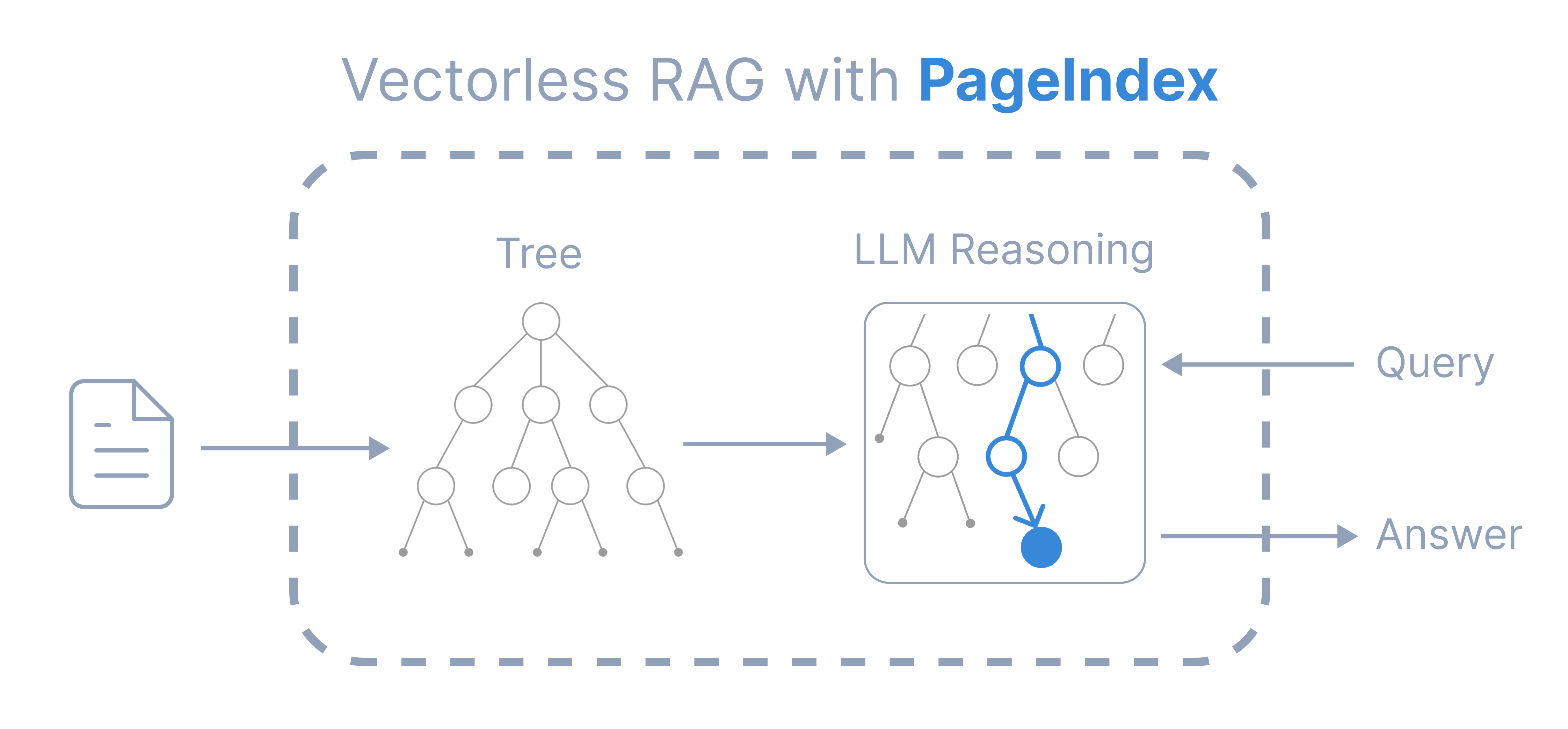
PageIndex performs retrieval in two steps:
1. **Generate a hierarchical tree index** - Similar to a "Table of Contents" but optimized for LLMs
2. **Perform reasoning-based retrieval** - Navigate the tree through LLM-powered tree search
## Reasoning-based RAG • No Vector DB • No Chunking • Human-like Retrieval
Are you frustrated with vector database retrieval accuracy for long professional documents? Traditional vector-based RAG relies on semantic **similarity** rather than true **relevance**. But **similarity ≠ relevance** — what we truly need in retrieval is **relevance**, and that requires **reasoning**.
Inspired by AlphaGo, **PageIndex** is a **vectorless**, **reasoning-based RAG** system that builds a **hierarchical tree index** from long documents and uses LLMs to **reason** over that index for **agentic, context-aware retrieval**. It simulates how human experts navigate and extract knowledge from complex documents through tree search.
Get PageIndex running on your first PDF in under 5 minutes
Install PageIndex and set up your environment
Understand the hierarchical tree index that powers PageIndex
Explore configuration options and advanced parameters
## How PageIndex Works
PageIndex performs retrieval in two steps:
1. **Generate a hierarchical tree index** - Similar to a "Table of Contents" but optimized for LLMs
2. **Perform reasoning-based retrieval** - Navigate the tree through LLM-powered tree search
 ## Core Features
Compared to traditional vector-based RAG, PageIndex features:
Uses document structure and LLM reasoning for retrieval, instead of vector similarity search
Documents are organized into natural sections, not artificial chunks
Simulates how human experts navigate and extract knowledge from complex documents
Retrieval is based on reasoning — traceable and interpretable with page and section references
## State-of-the-Art Performance
PageIndex powers a reasoning-based RAG system that achieved **98.7% accuracy** on FinanceBench, demonstrating superior performance over vector-based RAG solutions in professional document analysis.
See the [Mafin 2.5 benchmark results](https://github.com/VectifyAI/Mafin2.5-FinanceBench) for detailed comparisons and performance metrics.
## Deployment Options
Run locally with the open-source package
Try instantly with the Chat Platform or integrate via MCP/API
Private or on-prem deployment with dedicated support
## Next Steps
Generate your first PageIndex tree structure in minutes
See a minimal, hands-on example of reasoning-based RAG
## Core Features
Compared to traditional vector-based RAG, PageIndex features:
Uses document structure and LLM reasoning for retrieval, instead of vector similarity search
Documents are organized into natural sections, not artificial chunks
Simulates how human experts navigate and extract knowledge from complex documents
Retrieval is based on reasoning — traceable and interpretable with page and section references
## State-of-the-Art Performance
PageIndex powers a reasoning-based RAG system that achieved **98.7% accuracy** on FinanceBench, demonstrating superior performance over vector-based RAG solutions in professional document analysis.
See the [Mafin 2.5 benchmark results](https://github.com/VectifyAI/Mafin2.5-FinanceBench) for detailed comparisons and performance metrics.
## Deployment Options
Run locally with the open-source package
Try instantly with the Chat Platform or integrate via MCP/API
Private or on-prem deployment with dedicated support
## Next Steps
Generate your first PageIndex tree structure in minutes
See a minimal, hands-on example of reasoning-based RAG